|
|
|
|
|
 |
 |
|
||
|
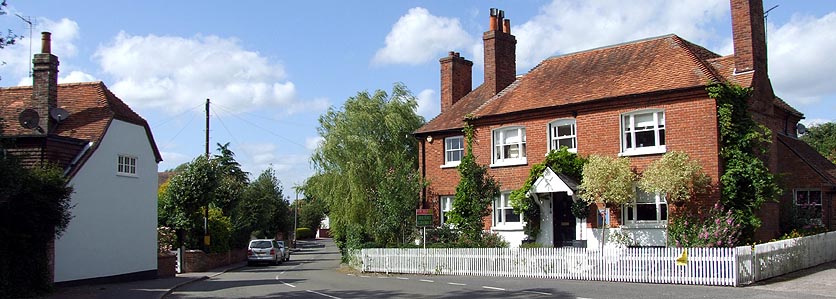
Chieveley Chieveley is now best known for its Service Station at the Newbury junction on the M4 motorway, but the place has a long history. Just south of the village, at Snelsmore, is Bussock Camp, an Iron Age hillfort standing on the high ground overlooking the Winterbourne Brook. Not much is known about it, but it may have been occupied between the third and second centuries bc, as there are tracks to Grimsbury Castle in Hermitage which dates from that period. It has four entrances, all on the east side, facing Grimsbury. The name of the village was originally Cifan-Lea. A name said, in a 10th century charter of King Edred, to have been given to the place a long time ago by the tillers of the soil. It is supposed to mean ‘Chive Clearing’ because of the wild chives that grow in the area, apparently introduced by the Romans. King John visited the village in 1207 and may have stayed at the grange there held by Abingdon Abbey. The monks also appear to have had a small cell at Bradley Court, east of the village, tending to lepers in the 1270s. Both these manors came into the hands of the widespread Pocock family in the late 16th century. The family produced a number of notable characters, including Adm. Sir George Pocock and the theologian, Edward Pocock, whose father was the local vicar. The Pococks of Raymead in Maidenhead are also said to have been their descendants: Capt. Sir Isaac Pocock, his brother Nicholas Pocock, the marine artist, and the latter’s sons, Isaac Pocock, the artist and dramatist, and Lieut. William Pocock. The parish church dates back to the 13th century. It has one of only three remaining Lenten Veil Screens in England. It was used for the hanging of a veil to screen off the altar during lent, but the practice was forbidden at the Reformation. Though the old inn, at North Heath just west of Chieveley, still exists as a restaurant, the name of the ‘Blue Boar’ has sadly gone. It concealed a fascinating story, for it was named after the large sandstone wild boar which was for centuries was used as its sign. It was one of a pair from Ripley Castle in Yorkshire, replicas of those at the Uffizzi Palace in Florence. It went missing when the Parliamentarians camped at Ripley on the eve of the Battle of Marston Moor in July 1644, suddenly reappearing at North Heath in the October. It seems that the Roundhead soldiers took a fancy to the boar and carried it halfway across the country until they stopped on the Heath before the Second Battle of Newbury. Waller’s men had been sent round from Clay Hill to attack, from behind, the Royalists at Speen. The march took about a day, but the army rested the night on North Heath. The officers stayed at the inn, Cromwell among them. See also other places in the ancient parish: Curridge, Leckhampstead, Oare & Winterbourne.
|
|
||
| © Nash Ford Publishing 2008. All Rights Reserved. | |
|||